

- Jul 12
- 4 min read
Finding Frontier Compute at the Source
How Infrastructure Ventures works with leading universities to identify frontier-tech founders early.
Most venture investors first encounter frontier-technology companies after they have entered the familiar fundraising networks around Silicon Valley or London. By that point, the strongest teams have often been seen by dozens of funds, and their valuations already reflect the competition.
We start from a different premise: talent is global, but commercial opportunity is concentrated. Some of the world's best engineers are trained in São Paulo, Istanbul, Lisbon and Bangalore, far from the networks where venture capital congregates. So rather than waiting for founders to find their way to us, Infrastructure Ventures goes to where the talent is formed: the universities.
Why these universities
Frontier compute, from artificial intelligence to quantum computing and decentralized infrastructure, does not begin at demo days. It begins in research groups and engineering classrooms, years before a company is formed. Meet the people doing that work early, and you meet the founders before the rest of the market knows they exist.
That is why our network is deliberately concentrated on institutions with world-class engineering whose graduates have far less access to customers and early-stage capital than their peers in California or the UK. The University of São Paulo is ranked by Times Higher Education as the leading university in Latin America for 2026. Koç University is its top-ranked institution in Türkiye. Instituto Superior Técnico helps the University of Lisbon rank first nationally for engineering and technology, and the University of Minho is ranked among Portugal's leading engineering research institutions. In India, we work with Presidency University in Bangalore, the country's technology capital.
We complement these emerging-market partnerships with universities in developed markets that hold a unique specialization in frontier compute. The University of Bristol is a global center for quantum engineering and the origin of our investment in PsiQuantum. The University of Cambridge, UC Berkeley and SRI International connect us to two of the world's deepest research ecosystems in computing and AI.

How we work with universities
Students and founders receive access to Infrastructure Ventures' training platform, with more than 100 hours of practical content and company-building case studies, supported by mentorship and office hours that help them apply the material to their own ideas.
But no two universities are organized the same way, so we do not force a single model onto all of them. We plug into whichever part of the institution is closest to its founders.
SPIN-OUT GROUPS
Partnering with the university’s startup engine
At some universities we work hand in hand with the incubation and spin-out group, supporting teams as they carry research out of the lab and into a company.
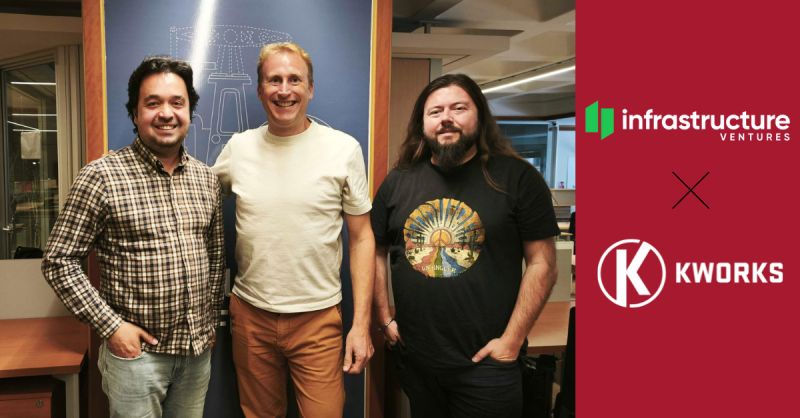
Example: KWORKS, Koç University’s incubation center, Istanbul
FACULTY
Embedded in the curriculum
At others we work directly with faculty, where our entrepreneurship training program is included as part of the final-year curriculum, reaching every graduating engineer, not just the self-selected few.
Example: Engineering faculty, University of São Paulo
ALUMNI
Helping alumni launch startups
And at others we work through the university’s alumni network, helping graduates who are ready to build take the step from idea to funded company.
Example: University of Cambridge alumni
The pipeline is already producing results.
Case Study
BreastScreening-AI
We were introduced to BreastScreening-AI at Instituto Superior Técnico in Lisbon. The company’s CEO went through our entrepreneurship training, including the “How to Raise Capital” module, while building a multimodal AI platform that supports radiologists with earlier breast-cancer detection.
Since then, the company has been selected for the European Innovation Council’s Pre-Accelerator, one of around 70 deep-tech startups chosen from more than a thousand European applications. It is ranked the #16 AI company in Portugal by F6S and has raised over $1 million in capital. The company is now part of the Infrastructure Ventures portfolio.
What we teach: the Silicon Valley way
The substance of the training is the company-building discipline that Silicon Valley takes for granted: customers first. Students learn to investigate whether a problem is important enough to solve and whether customers will pay for a better solution before committing months to product development. The goal is not to discourage ambitious technology. It is to avoid the surprisingly persistent habit of building something first and searching for a reason afterwards.
The key shift is from “What can we build?” to “What will a customer pay us to solve?”
Earlier this year, we extended the approach into India through MOI. Its six-week MOI Forge program is currently running at Presidency University in Bangalore, with Infrastructure Ventures' entrepreneurship training introduced during the later part of the program. The technical curriculum teaches students what they can build; our contribution helps them decide what is worth building and how to validate the demand behind it. For future university engagements, the two programs will be proposed together from the outset.
Teaching this way also sharpens our judgement as investors. It lets us watch how potential founders approach customers, and how readily they adapt when the evidence challenges their original idea. The most promising teams then progress into our investment and commercialization network.
Scaling in Silicon Valley
Finding companies early is only useful if we can also help them scale, and scale happens where customers and capital are concentrated. Our first scale hub is Silicon Valley, where Infrastructure Ventures has an on-the-ground presence and a network that connects founders with potential customers and investors.
$122B
Raised by Bay Area AI companies in 2025: more than three-quarters of US AI funding and roughly 60% of the global total (Crunchbase).
Top 5
The five largest venture financings in the world in early 2026 all went to Bay Area companies.
Those figures are heavily influenced by a small number of very large rounds, but they still illustrate why local access matters. Silicon Valley remains the place where many of the leading frontier-technology companies and venture funds operate in close proximity. Our presence there helps founders develop relationships over time, since trust is more often built through repeated contact than through a single introductory email.
Later in 2026, we plan to establish another scale hub in Asia. This will give companies in our network a practical route into one of the world's fastest-growing technology markets, while also expanding our ability to identify promising founders across the region.

Comments